Halo
Explainable resonance suppressorIt shows its work.
Dynamic resonance control that shows its work.
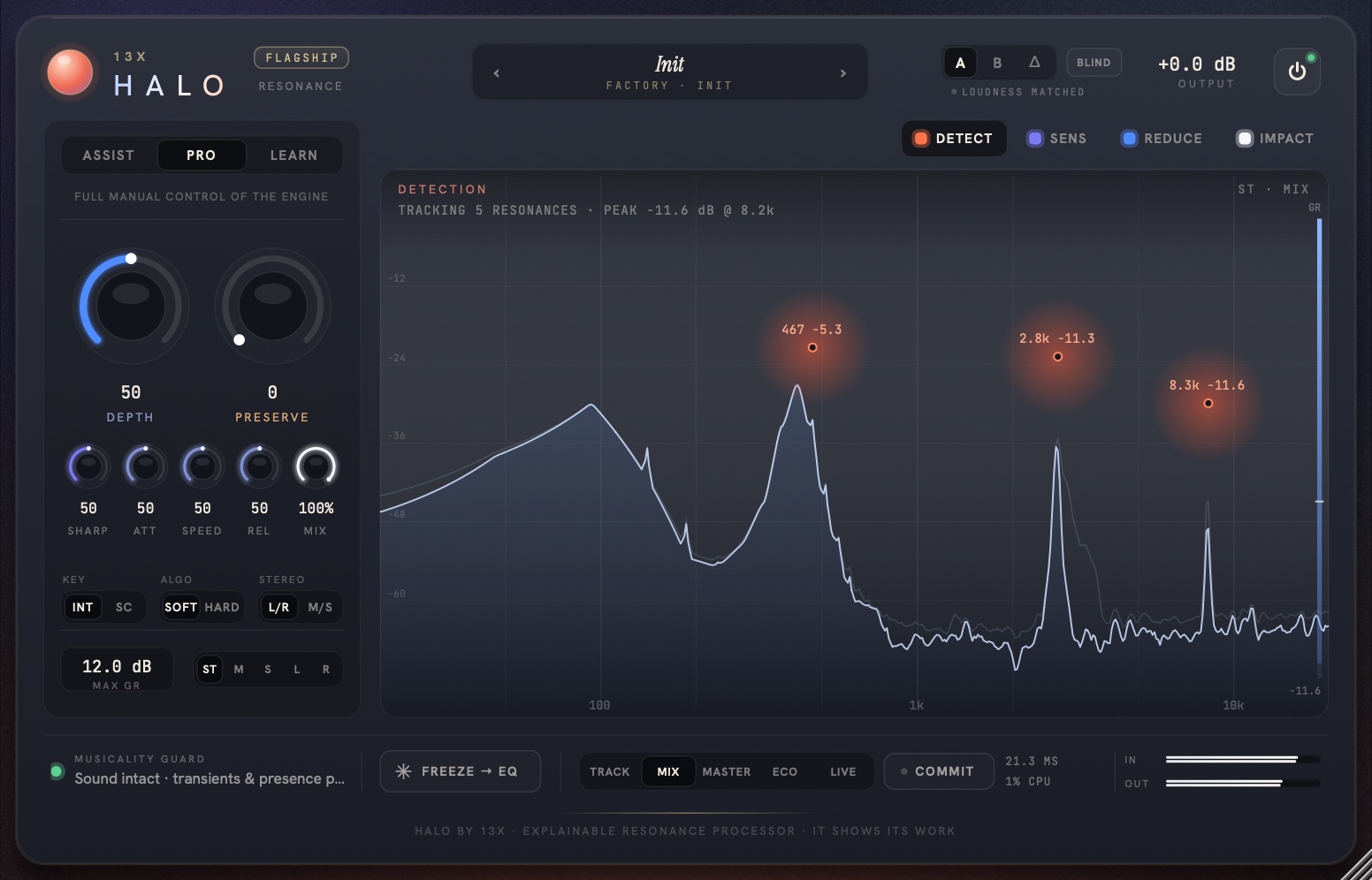
The resonance leaves. The reasoning stays.
Halo is a resonance suppressor with a working principle the category usually hides: it tells you what it heard. Point it at a vocal, a cymbal bus or an acoustic and it tracks the sharp, ringing peaks that read as harsh — then LEARN mode classifies each finding as static, moving or bursts, states its confidence, and explains the call in plain words. One click turns the reasoning into the setting, and the delta solo plays only what's being removed, so you can prove it's taking the harshness and nothing else.
Underneath sits a per-frequency spectral engine tuned to stay musical. PRESERVE protects transients and bite; attack and release trim the ballistics around one SPEED macro; a SOFT/HARD switch goes from polite smoothing to a narrow, de-esser-style clamp. Focus runs the full 20 Hz – 20 kHz with soft shoulders, in stereo or mid-side — or key another track into the detector and Halo unmasks the bed only where the vocal actually lives.
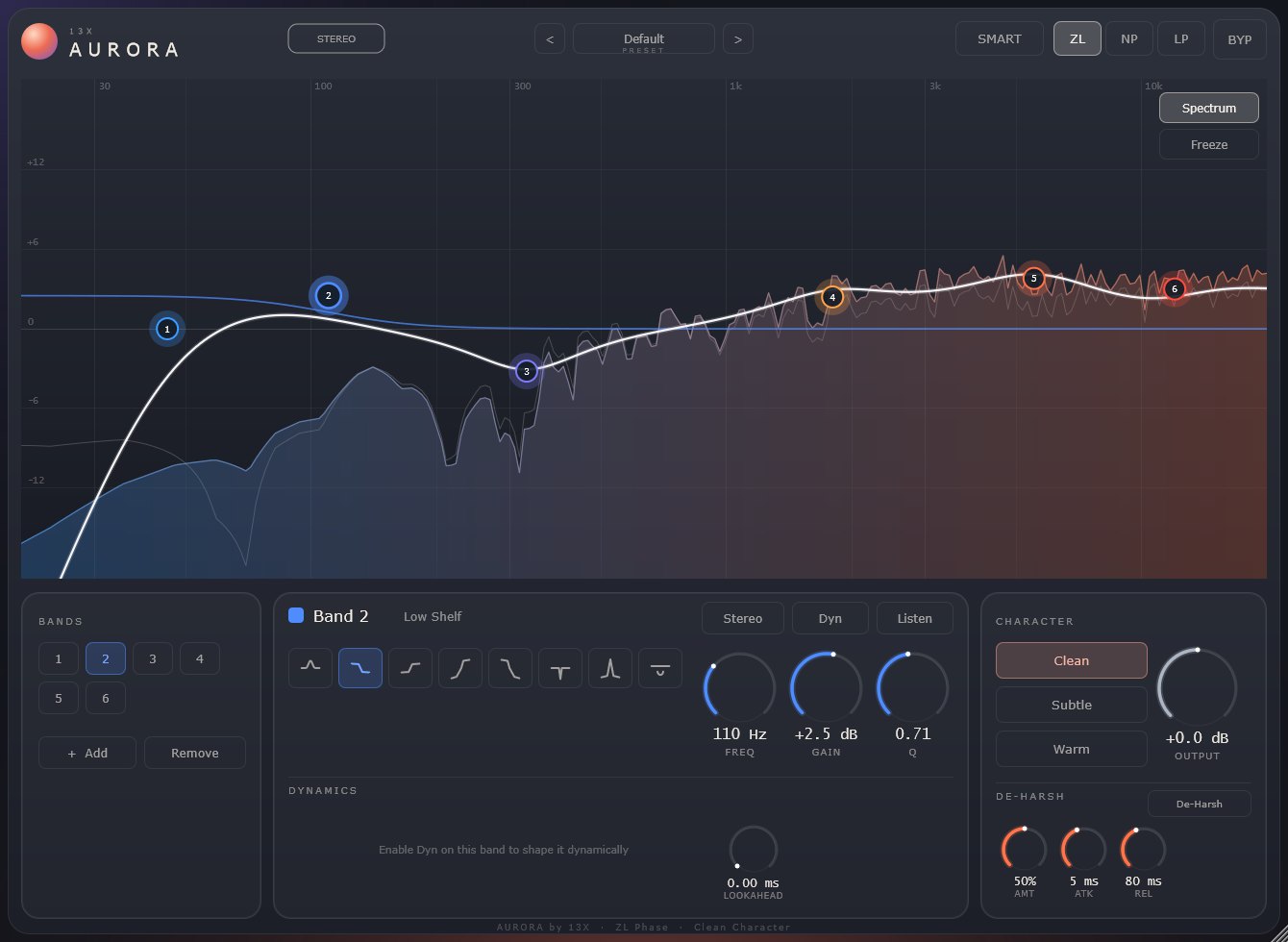
Fixed problems get fixed once: FREEZE captures what Halo is hearing as a ranked list of static notch moves — applied in the built-in eight-band stage, or exported as text and JSON. 92 problem-oriented presets in eleven folders audition on a single click, a loudness-matched blind A/B keeps your judgement honest, and five quality modes run from mastering-grade HQ overlap down to a 5.3-millisecond LIVE mode. AURORA's De-Harsh is a taste of this — Halo is the idea taken all the way.
Every move it makes — explained on screen.
It tells you why.
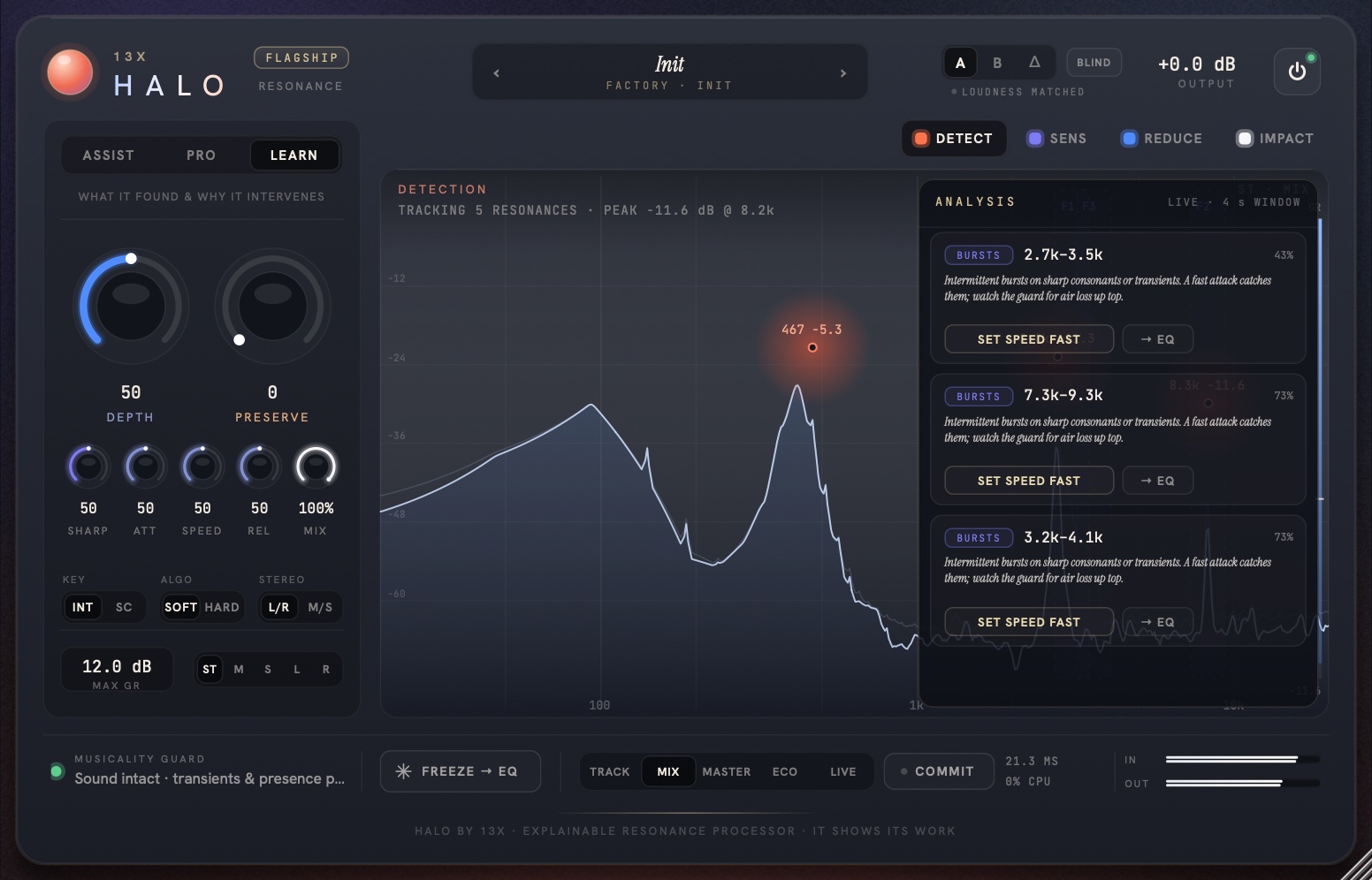
Halo classifies every finding — STATIC (a fixed tone, best removed once), MOVING (follows the part, stays dynamic), BURSTS (sibilance-like spikes, gets a fast attack) — with a confidence figure and a plain-words explanation. One click turns the reasoning into the setting.
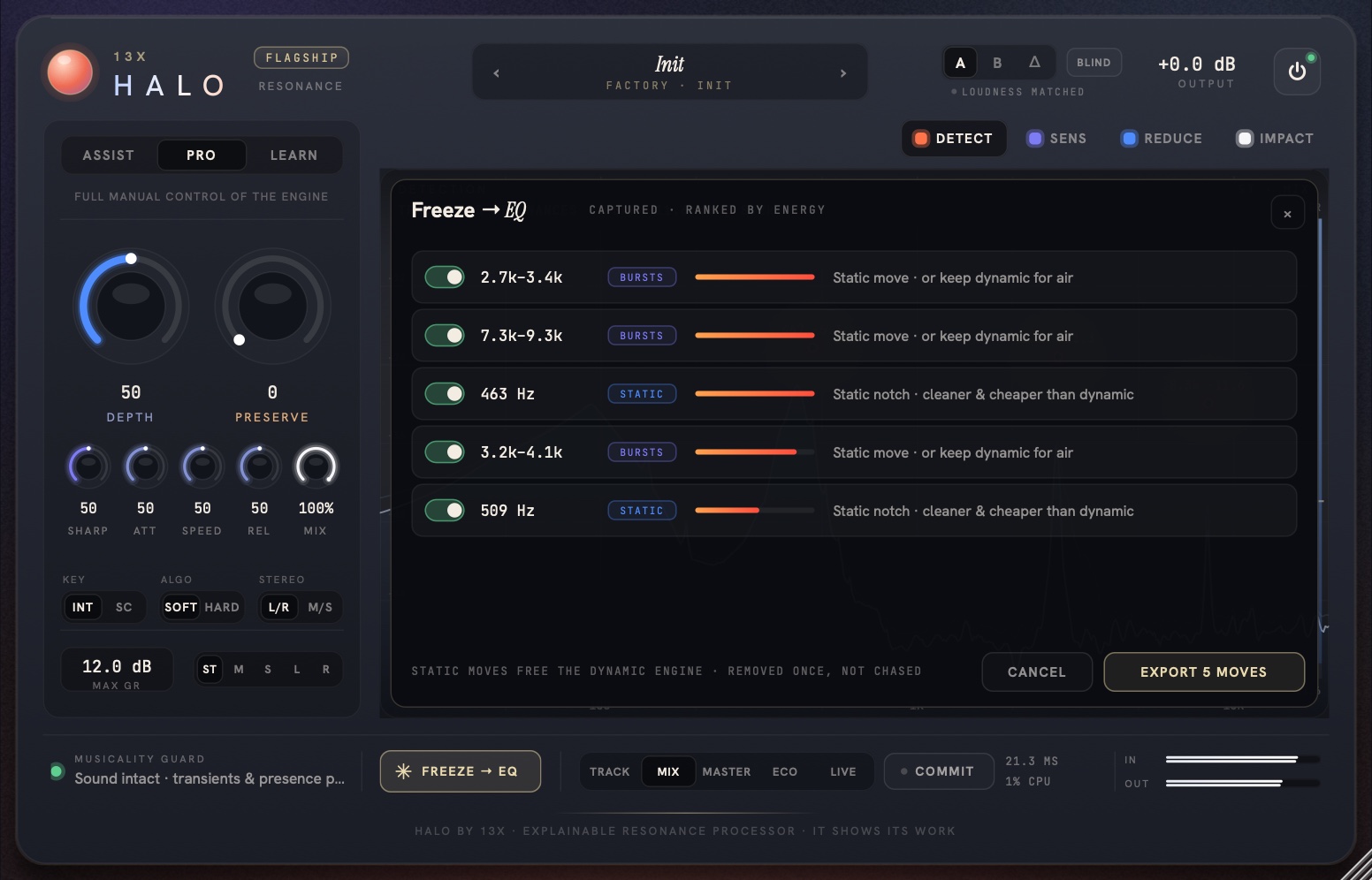
Fixed problems get fixed once.
A resonance that never moves shouldn't eat dynamic headroom forever. FREEZE captures the findings as a ranked list of static notch moves — toggle each one, apply them in the built-in eight-band notch stage, or export the list as text and JSON for your EQ.
92 starting points. Eleven folders.
Problem-oriented presets — “Snare: ring control”, “De-ess without lisp”, “SC: kick vs bass” — with search, factory/user/favourite filters and single-click audition. Save yours into folders, star favourites, and mark one as the default every new instance opens with.
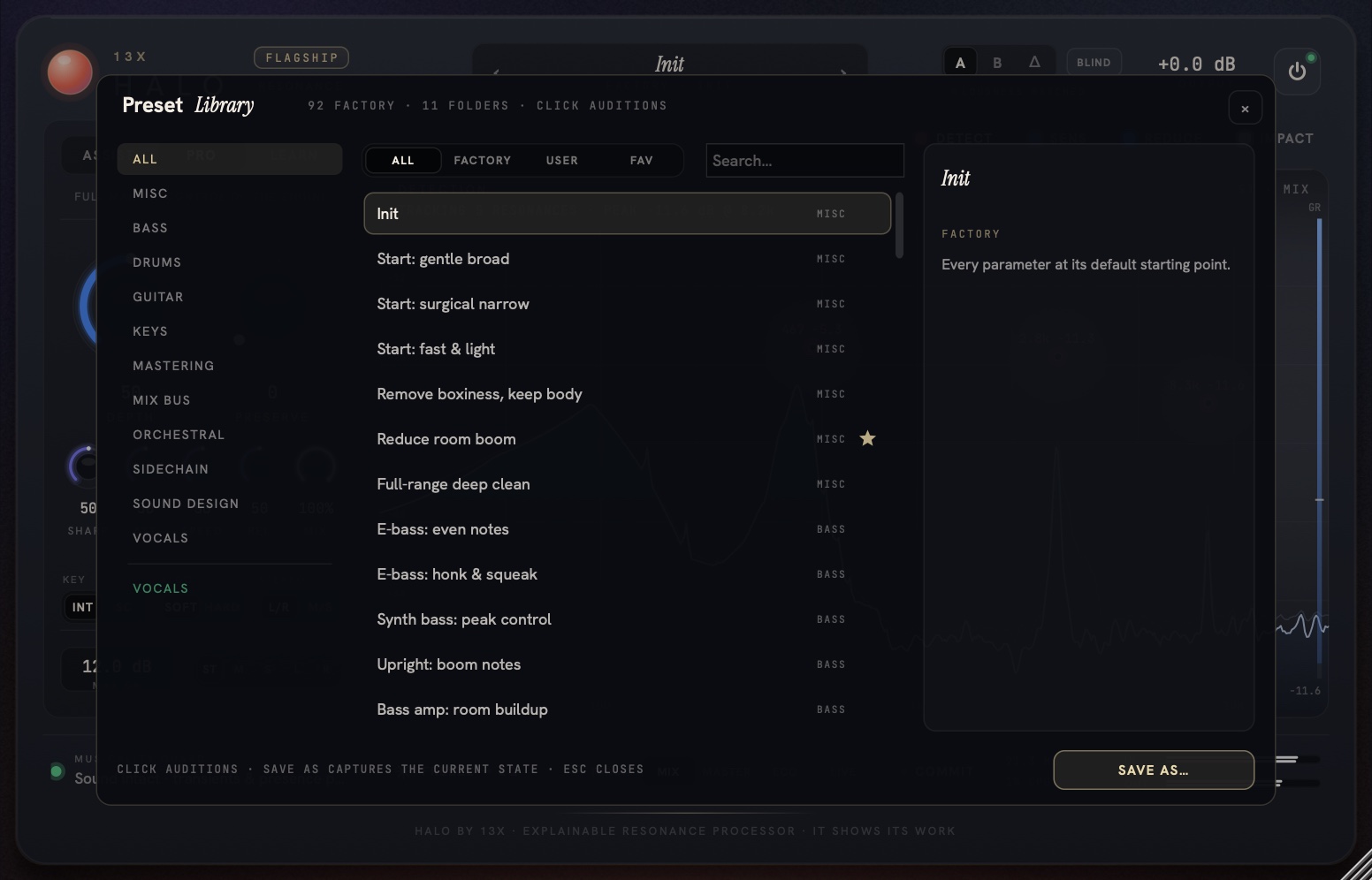
- Misc
- Bass
- Drums
- Guitar
- Keys
- Mastering
- Mix Bus
- Orchestral
- Sidechain
- Sound Design
- Vocals
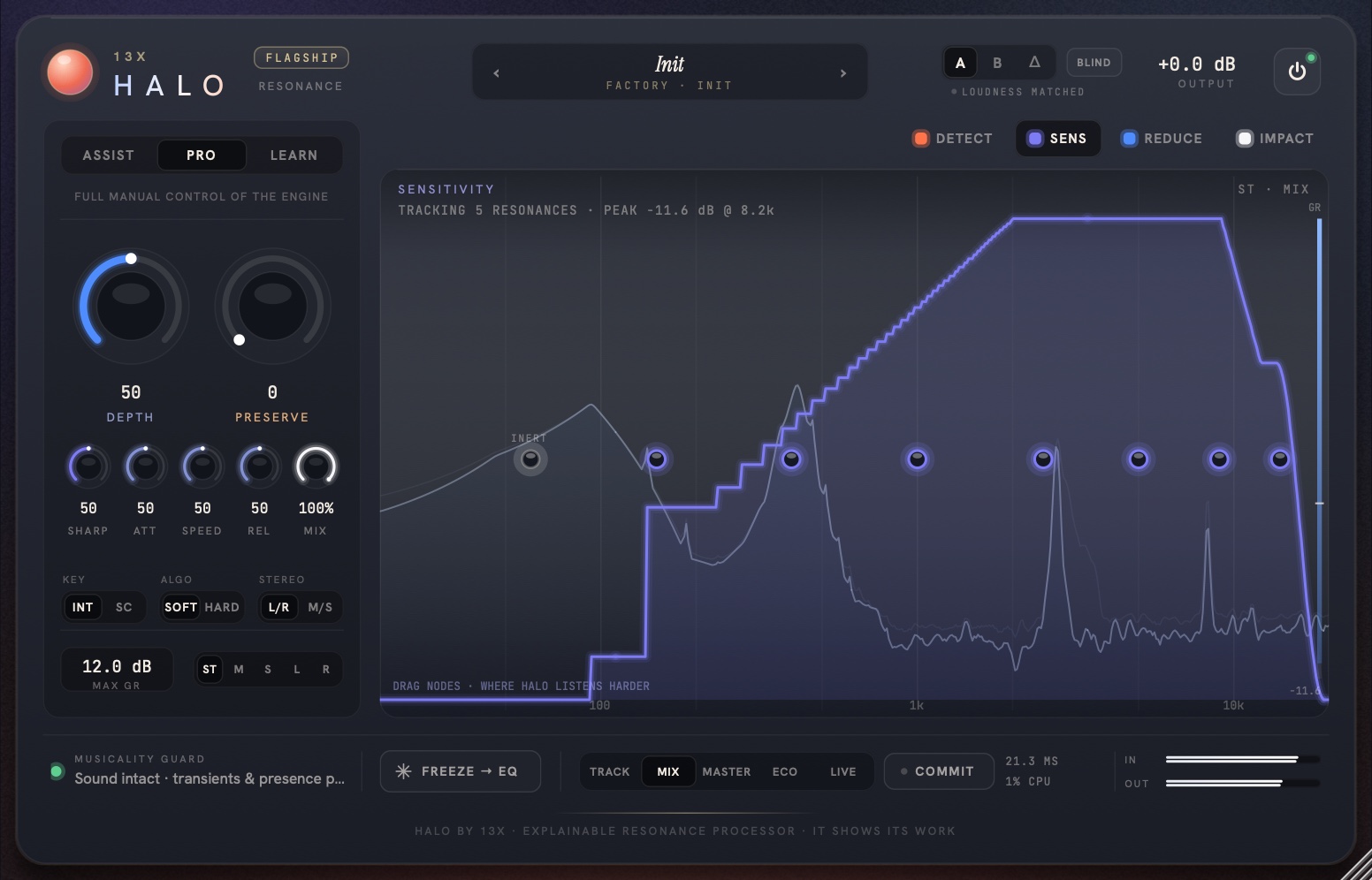
Musical by default. Surgical on demand.
PRESERVE keeps transients and bite; attack and release trim the ballistics around one SPEED macro; SOFT smooths politely while HARD bites at a narrow knee, de-esser style. Focus runs the full 20 Hz – 20 kHz — in stereo, mid-side, or keyed from a sidechain.
Everything inside Halo.
- Explainability
- LEARN — findings classified static / moving / bursts, with confidence
- Delta solo — audition only what's being removed
- IMPACT view — long-term spectral delta: presence, air, body, drift
- Musicality Guard — warns before you overdo it, with an APPLY fix
- Detection & engine
- Full-range focus 20 Hz – 20 kHz with soft half-octave shoulders
- Eight sensitivity nodes — weight where it listens harder
- SOFT / HARD algorithm + PRESERVE transient protection
- Attack & release trims (±4×) around the SPEED macro
- Routing & judgement
- Stereo / Mid-Side processing · ST/M/S/L/R monitoring
- Sidechain-keyed detection — unmask against any source
- Loudness-matched blind A/B — X/Y hides the labels
- Undo / redo through every move — one preset, one step
- Presets & quality
- 92 factory presets in 11 folders — single-click audition
- Freeze → EQ — built-in notch stage, clipboard & JSON export
- TRACK · MIX · MASTER (HQ overlap) · ECO · LIVE
- LIVE: 5.3 ms latency, 1,500 gain updates a second
- Included, foreverLifetime updates
- Every future update included — new features, new content, fixes
- No subscription — you get it once, it keeps growing
- No upgrade fees, no version-2 tax
- Yours for life, in every copy
Where Halo earns its place.
Vocals
Tame 2–5 kHz harshness and sibilant ring without dulling the take — four de-ess presets ship as starting points, from soft to heavy-duty.
Cymbals & overheads
Pull the piercing ring out of a bright kit while the shimmer and transients stay — LEARN shows exactly which peaks are the problem.
Acoustic & guitars
Chase boxy body resonances and amp fizz — then freeze what never moves into static notches and keep the dynamic engine for the rest.
Bus & master
MASTER mode's high-density overlap keeps gentle full-mix suppression smooth — and the IMPACT view is the receipt for what changed.
Halo
Explainable resonance suppressor
- Formats
- VST3 · AU · Standalone
- System
- macOS 11+ · Windows 10/11
- Processing
- Per-frequency spectral · Stereo / Mid-Side
- Monitoring
- Delta solo · blind A/B · IMPACT view
- Presets
- 92 · 11 folders
- Latency
- 5.3 – 42.7 ms · mode-dependent
92 factory presets · Factory — 11 folders bank.
Runs where you work.
- Operating system
- macOS 11+ (Apple Silicon & Intel, universal) · Windows 10/11 (64-bit)
- CPU
- Modern 64-bit CPU — Apple Silicon, Intel or AMD
- Memory
- 4 GB RAM minimum
- Plug-in host
- Any VST3 / AU DAW — FL Studio, Ableton, Logic, Bitwig, Cubase, Reaper… · runs Standalone
- Formats
- VST3 · AU · Standalone — 64-bit only (CLAP build-ready)
- Quality modes
- TRACK · MIX · MASTER (HQ overlap) · ECO · LIVE
- Latency
- 5.3 ms (LIVE / ECO) to 42.7 ms (MASTER) at 48 kHz — reported to the host
- Sample rates
- 44.1 – 192 kHz
- Validation
- pluginval strictness 10 · Apple auval · 94 automated tests
- Authorization
- License key · up to 3 machines · works offline
How is Halo different from AURORA's De-Harsh?
AURORA's De-Harsh is a lite, one-knob taste of this. Halo is the dedicated tool: LEARN-mode explanations, Freeze → EQ export, 92 presets in 11 folders, sidechain-keyed unmasking, five quality modes — and a monitoring set (delta solo, loudness-matched blind A/B, long-term IMPACT) built to prove every move.
Is Halo a Soothe alternative?
It's built for the same job — dynamic, per-frequency resonance suppression that acts only when a frequency actually spikes. The difference is the working principle: Halo explains what it found and why it intervenes, and its delta, blind-A/B and IMPACT views exist to verify the result, not just promise it.
What does “it shows its work” mean in practice?
Three things. LEARN classifies every finding — static, moving or bursts — with a confidence figure and plain-words reasoning. Delta solo plays only what's being removed. And the IMPACT view keeps a long-term account of what changed: presence, air, body and drift.
Can I track through it live?
LIVE mode runs at 5.3 ms latency (256 samples at 48 kHz) while updating gain 1,500 times a second, so monitoring stays comfortable and the suppression stays smooth. TRACK at 10.7 ms is the everyday recording default.
What formats and systems will Halo support?
VST3, AU and Standalone on macOS 11+ (universal — Apple Silicon & Intel) and Windows 10/11 (64-bit), validated with pluginval at strictness 10 and Apple's auval. A CLAP build is prepared; AAX is on the roadmap.
When does Halo launch?
It's in the studio now, in final sound tuning. Join the list and you'll be first to know — AURORA users get a founder discount at launch.
They’re built to sit together.
One interface language across the whole rack. Add a piece, or take the Complete Collection.